
Travel guide
Menorca's prehistoric sites: the Talayotic route best done by car
Among coves and dry-stone fields, Menorca hides one of the world's most impressive archaeological ensembles. In 2023 UNESCO declared Talayotic Menorca a World Heritage Site, recognising almost 1,600 prehistoric sites spread across the island: one of the highest densities on the planet. Talayots, taulas and navetas form a genuine open-air museum. And since the sites are scattered across the island's interior, from Maó to Ciutadella, the best —almost the only— way to tour them at leisure is by car. Here's what they are and how to plan the route.
Talayot, taula and naveta: learn to tell them apart
Before setting off, it helps to know what you'll see, because these are unique structures:
- Talayot: truncated cone-shaped stone towers (they give the culture its name). They served as lookouts, defence and a symbol of the community. Around 300 are spread across the island.
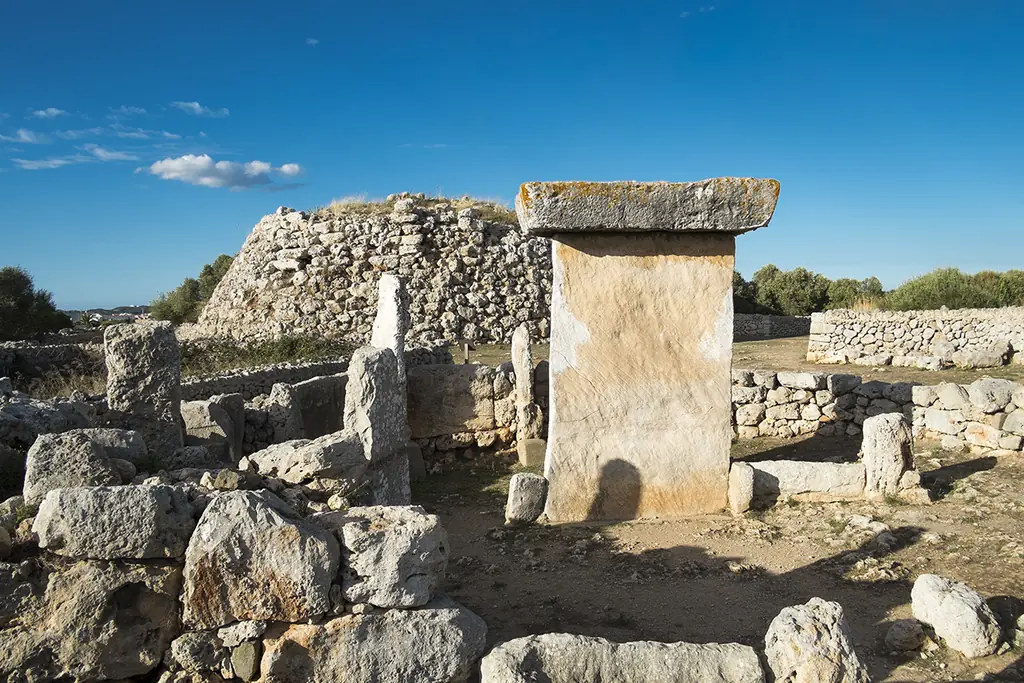
- Taula: the most mysterious monument and exclusive to Menorca (found nowhere else in the world). A great stone "T" —a vertical pillar with a slab on top— that presided over ritual enclosures.
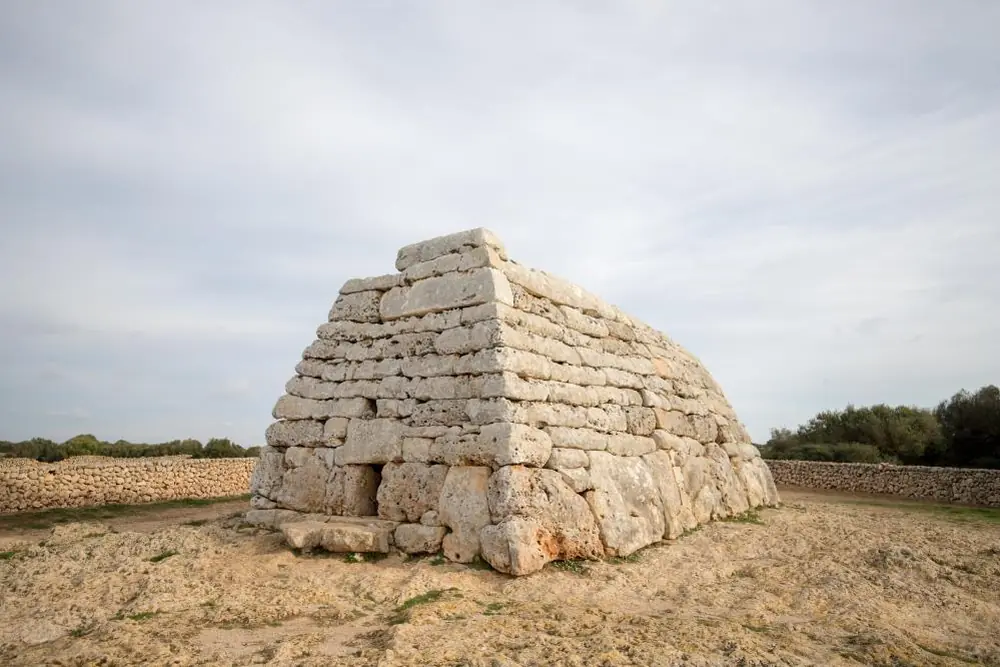
- Naveta: collective tombs shaped like an upturned boat, also unique to Menorca. Dozens of people were buried in them.
The Talayotic route: from Maó to Ciutadella
The most logical way to organise it is from east to west, following the Me-1 main road that crosses the island's interior, with detours to each site. These are the essentials, ordered from Maó to Ciutadella:
Near Maó: Trepucó and Talatí de Dalt
Just 2 km from Maó lies the Trepucó settlement, one of the largest on the island, with two talayots and a colossal taula (its vertical stone is over 4 metres tall). Nearby, Talatí de Dalt is one of the most photogenic sites: its taula, with a pillar leaning in an almost impossible way, rises among centuries-old olive trees. Both make a perfect first stop right out of the capital.
Between Maó and Alaior: Rafal Rubí and Torralba d'en Salort
On the way to the island's centre you'll find the navetas of Rafal Rubí, two prehistoric tombs, "little sisters" of the famous des Tudons. And above all Torralba d'en Salort, one of the best-preserved settlements: its taula is among the most imposing on the island (a 4.30 m pillar), with talayots, a hypostyle hall and a cyclopean wall. In season they organise sunset visits, a very special experience.
In Alaior: Torre d'en Galmés, the great settlement
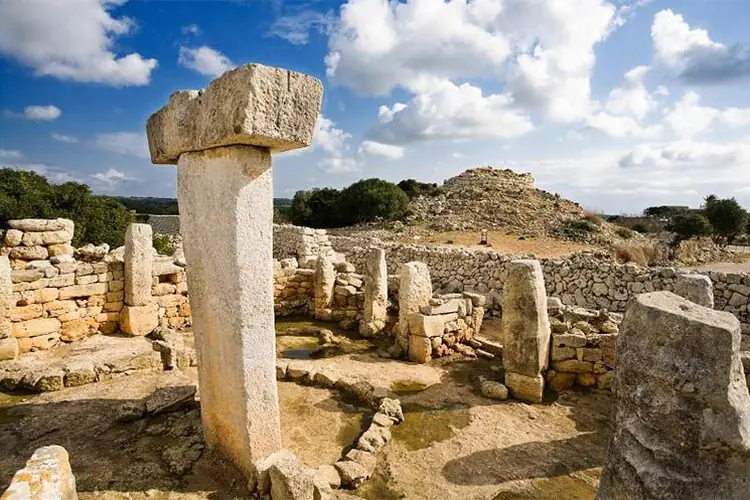
If you can only see one site, make it Torre d'en Galmés: the largest prehistoric settlement in Menorca (over 6 hectares), on a hill with views over the entire south coast —on clear days you can see Mallorca—. It preserves three talayots, a taula enclosure, circular houses, hypostyle halls and an ingenious water-collection system carved into the rock. It has an interpretation centre and needs at least two hours: take your time.
Near Ciutadella: the Naveta des Tudons
The jewel in the crown and Menorca's most iconic image: the Naveta des Tudons, 6 km from Ciutadella, visible from the road itself. It's a collective tomb where the remains of around a hundred people were found, and —an astonishing fact— it's the oldest fully preserved building in Europe: 1,200 BC, about 800 years older than the Parthenon in Athens! A compulsory stop before entering Ciutadella. Nearby are also the taulas of Torretrencada and the Torrellafuda settlement, hidden in a wild-olive wood.
Practical tips for the visit
- Closed shoes and water: the terrain is uneven (stone, earth) and there's little shade. In summer, go first or last thing.
- Check opening times: some sites have free access and others have hours and an entrance fee; they vary by season. Confirm before going.
- Respect the monument: don't climb on the stones or move anything. It's 3,000-year-old heritage.
- Combine with beach or village: many sites are near southern coves, so you can mix history and a swim in the same day.
- Starlight sky: Menorca is a Starlight Reserve; some sites offer night-time stargazing activities in summer.
Why this route needs a car
The Talayotic sites are spread across the interior, often at the end of rural tracks with no public transport, and to see them properly you hop from one to another through the day. With a rental car you drive the east-west route at your own pace, stop where you like and combine archaeology with coves and villages. If you arrive by plane, we offer car hire at Menorca Airport with delivery at Parking P1, a fixed price with no excess or deposit and unlimited mileage to tour the whole island. And to round off your trip, take a look at the what to see in Menorca guide and the north-south guide.
Official sources
- Talayotic Menorca on the UNESCO World Heritage List
- Menorca Talaiòtica Agency: official site with sites, opening times and visits
Travel through 3,000 years of history at your pace
From Trepucó to Naveta des Tudons. Car with unlimited mileage, no excess or deposit.
Book your carFrequently asked questions
What is Talayotic Menorca?
It's the island's ensemble of prehistoric sites, declared a UNESCO World Heritage Site in 2023. It brings together almost 1,600 monuments (talayots, taulas and navetas) spread across Menorca, one of the highest archaeological densities in the world. Taulas and navetas are unique structures found nowhere else.
What are the must-see Talayotic sites?
The most notable, east to west, are: Trepucó and Talatí de Dalt (near Maó), the Rafal Rubí navetas and Torralba d'en Salort (between Maó and Alaior), Torre d'en Galmés (the largest settlement, in Alaior) and Naveta des Tudons (near Ciutadella), the island's most iconic monument.
Do you need a car to see Menorca's prehistoric sites?
Practically yes. The sites are spread across the island's interior, many at the end of rural tracks with no public transport, and the route runs from Maó to Ciutadella with detours. A rental car lets you tour them at your pace and combine them with coves and villages.
How old is the Naveta des Tudons?
The Naveta des Tudons dates from around 1,200 BC and is the oldest fully preserved building in Europe: about 800 years older than the Parthenon in Athens. It's a collective tomb where the remains of at least a hundred people were found.